Salad Days Summer Film Screening Program
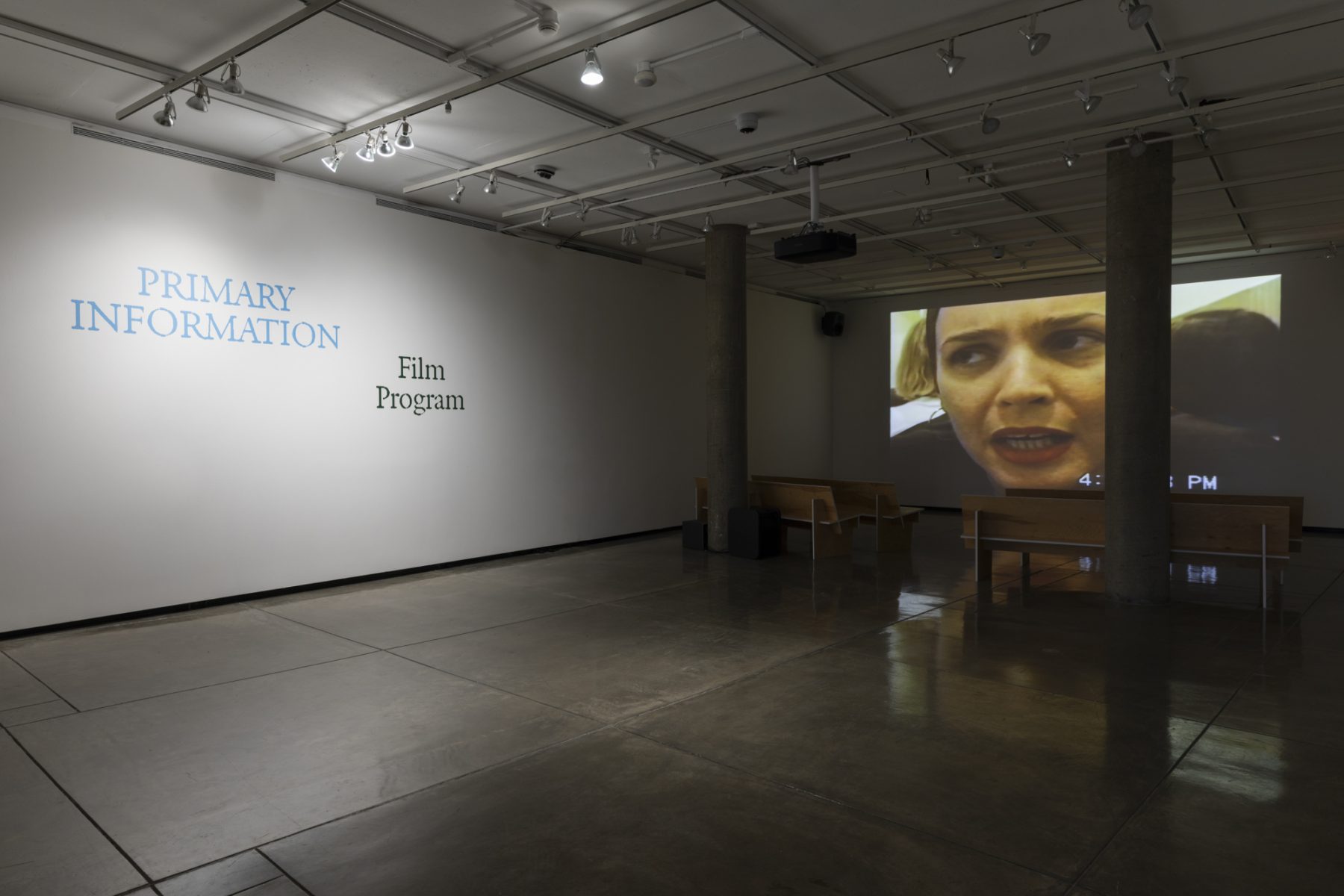
Summer Film Screening Schedule
Accompanying Salad Days: Primary Information, this summer a screening series expands on the ideas, histories, and artistic practices represented in the project. Each week, the Carpenter Center will present a film by an artist published by or connected to Primary Information, offering audiences an opportunity to encounter their work beyond the page. Through film and video, the screening program highlights the ways artists have used moving images, performance, and experimental media alongside publishing as sites for artistic inquiry and exchange.
Lutz Bacher, Do You Love Me? (1994)
June 18–21
In this twelve-hour video work, Lutz Bacher interviews friends, family members, artists, and colleagues about the artist and her life. While Bacher serves as the point of departure, the conversations often reveal as much about the interviewees as they do about their subject. Presented as a continuous loop.
Digital video, color, sound, 739 minutes.
Martha Wilson / DISBAND, 1979 Performance at MoMA PS1 (1979)
June 25–28
Founded by Martha Wilson, Daile Kaplan, and Barbara Ess, DISBAND emerged from New York’s downtown No Wave scene as an “all-girl conceptual art punk band.” Embracing a deliberate lack of musical training, the group challenged conventions of both performance and music while exploring feminist and conceptual art practices.
Stephanie Coleman, St. Valentine's Day Massacre Ball (1992)
July 2–5
This documentary captures footage from Chicago’s ballroom scene, including the Unity Ball (1991) and the St. Valentine’s Day Massacre Ball (1992), hosted by the pioneering House of Avant-Garde. Founded in the 1980s as Chicago’s first ballroom house, the organization provided a vital space for Black LGBTQ+ youth to gather, compete, and express themselves.
Dan Graham, Rock My Religion (1983–84) + Dara Birnbaum, Liberty: A Dozen or So Views (1976)
July 9–12
Dan Graham’s influential video essay traces connections between religious revivalism and rock music, examining the cultural and ideological forces that shaped postwar American youth culture.
Paired with Graham’s work, Dara Birnbaum’s Liberty: A Dozen or So Views combines interviews conducted aboard the Staten Island Ferry with views of the Statue of Liberty, exploring identity, representation, and the construction of American ideals.
Lawrence Abu Hamdan, 45th Parallel (2022)
July 16–19
Filmed at the Haskell Free Library and Opera House, a building that straddles the border between Canada and the United States, 45th Parallel explores the human stories that unfold within this unusual geopolitical space. Performed by filmmaker Mahdi Fleifel, Abu Hamdan’s four-act monologue reflects on migration, surveillance, family reunification, and the lived realities of borders.
Tiffany Sia, What Rules the Invisible (2022)
July 23–26
Drawing from archival travel footage shot in Hong Kong across the twentieth century, Tiffany Sia’s film examines recurring visual tropes embedded within the traveler’s gaze. Through repetition and recontextualization, the work reflects on memory, displacement, and the politics of looking.
Luke Fowler, Pilgrimage from Scattered Points (2006)
July 30–August 2
Luke Fowler’s documentary explores the life of English composer Cornelius Cardew and the experimental Scratch Orchestra, whose radical premise was that anyone could make music. Combining interviews, archival materials, and rare recordings, the film traces the collective’s rise and eventual dissolution while reflecting on the possibilities and contradictions of artistic collaboration.
Barbara T. Smith, Outside Chance (1975)
August 6–9
In this landmark performance, Barbara T. Smith collaborated with computer scientist Richard Rubenstein to generate 3,000 unique computer-produced snowflake prints. Transporting the prints to the twenty-first floor of a Las Vegas hotel, Smith released them into the air, transforming data, chance, and technology into a fleeting public event.
Destroy All Monsters, Film Program
August 13–16
Founded in Ann Arbor, Michigan in 1973, Destroy All Monsters brought together artists, musicians, filmmakers, and writers in a collaborative practice that blurred the boundaries between visual art, performance, and underground culture. This screening program presents a selection of rarely seen films and moving-image works connected to the group, highlighting their experimental approach to media, sound, and performance and their lasting influence on punk, noise, and contemporary art.
View related exhibitions
Archive
Explore more of our rich history through our archive.